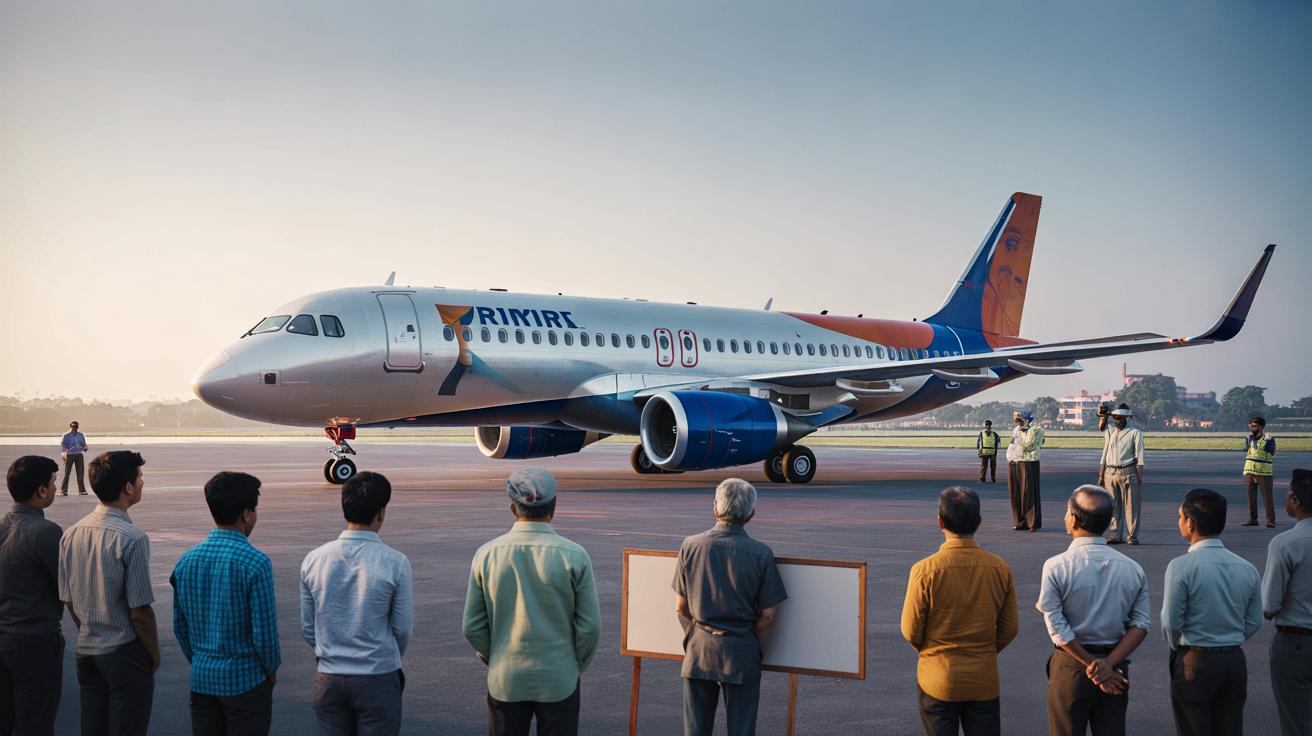
On a hazy morning at Hyderabad’s Begumpet airport, the crowd didn’t look like your usual airshow audience. There were software engineers in faded jeans, retirees with folding chairs, a cluster of students with homemade signs that simply read: “Fly Indian”. Phones went up in a forest of raised arms as a sleek white fuselage rolled slowly into view, its tail painted in bright saffron and deep blue.
What everyone was staring at wasn’t another Airbus or Boeing demo tour. It was something most people still think sounds like science fiction: a brand‑new passenger jet designed and built by an Indian company.
For a moment, you could feel a quiet, stubborn sort of pride in the air.
Then the engines spooled up, and India’s aviation story took a sharp turn.
India quietly builds what everyone said it couldn’t
For years, the global jetliner game has been a two‑and‑a‑half player story: Boeing, Airbus, and a cautious footnote for newcomers like the Chinese C919. India, despite its booming airlines and packed airports, stayed firmly in the “big customer” column, not the “builder” one.
Now that mental map is being redrawn. A homegrown project, long whispered about in aerospace circles, has stepped into the light with a clear, almost audacious ambition: an Indian-made passenger jet certified to fly commercial routes, not just military or regional experiments.
This isn’t just a badge of national pride. It’s a direct challenge to how we imagine where high‑tech, high‑risk aviation innovation can come from.
The roots of this jet didn’t start in some gleaming Silicon Valley hangar. They started in a low‑slung building outside Bengaluru, where a mix of grizzled Hindustan Aeronautics Limited veterans and 20‑something avionics coders stared for months at digital wind tunnels on battered monitors.
Out of that unlikely mix emerged a 90–110 seat narrow‑body concept aimed straight at regional routes that today depend almost entirely on imported aircraft. The project drew quietly on India’s experience with the Tejas fighter, its long history in licensed aircraft production, and a new wave of private suppliers that usually build parts for Airbus or Boeing.
One engineer described the moment the full‑scale mock‑up came together as “watching an arranged marriage between old‑school machining and cloud‑based aerodynamics”.
➡️ A polar vortex disruption is on the way, and its magnitude is almost unheard of in March
Why does this matter beyond the buzz and the patriotic headlines? Because civil aviation is one of the last, toughest industries where emerging economies rarely break through.
Designing a safe, efficient, certifiable airliner is a marathon full of brutal checkpoints: global safety rules, billions in financing, a ruthless supply chain, and airlines that will not gamble on unreliable planes. Most countries stare at that mountain and quietly back away.
India is doing something different. It’s aiming at the gap between the regional turboprop and the big single‑aisle jets, betting that its own market growth, its IT depth, and rising manufacturing muscle can carry a project that once belonged only to the US, Europe, and, lately, China.
An Indian jet in the age of delayed deliveries and packed flights
If you’ve flown recently in India, you’ve felt it: overbooked flights, stretched schedules, and that sense that every Airbus A320 and Boeing 737 is flying one extra leg a day. Airlines across the country have been on a record shopping spree, placing orders for hundreds of jets that won’t arrive for years.
That backlog is part of the story. With Boeing stuck in its own production drama and Airbus building as fast as it dares, airlines from Delhi to Dubai are quietly asking the same question: who else can build a safe, modern, mid‑range jet at scale?
Into that squeeze walks an Indian entrant with a simple pitch — if the planes are good, why should the factory be on another continent?
One regional carrier boss, speaking off the record, described how the pitch landed in his boardroom. His airline serves second‑tier cities where passenger demand has exploded faster than runway extensions or terminal upgrades.
“They showed us a cabin layout configured for 98 seats,” he said. “The range fits exactly our trunk routes. And the operating cost projections didn’t look crazy.”
Nobody signed anything that day. Airline people are naturally skeptical. But the fact that executives even stayed in the room for a full‑day technical workshop on an *Indian‑built* jet would have been unthinkable a decade ago.
That’s how shifts in industry confidence begin: not with fanfare, but with long, serious meetings that could have been brushed off with a polite email.
Behind the scenes, the logic runs deeper than national pride or convenience. India already has one of the world’s fastest‑growing aviation markets, with millions of first‑time flyers stepping onto planes every year. Every extra jet on those routes is money leaving the country in purchase contracts, maintenance deals, and leasing fees.
An indigenous passenger jet doesn’t erase that overnight. But it creates a different kind of leverage. Local airlines can negotiate harder, regulators can nurture a domestic ecosystem of suppliers, and skilled jobs stay closer to where the tickets are sold.
Let’s be honest: nobody really reads an aircraft spec sheet before booking a flight on their phone. Yet the badge on the nose of that jet says a lot about who is shaping the next 30 years of aviation — and who is just paying the bills.
What it actually takes to build a passenger jet in India
Strip away the glamour shots and you’re left with something much less glossy: process. The Indian team behind this new jet spent years just on one unsexy task — stitching together a supply chain that could deliver thousands of flawless parts on time.
They visited machine shops in Pune, composite specialists in Gujarat, software labs in Hyderabad, and even small family firms that used to mill components for scooters, now re‑tooled to aerospace grade. Each visit meant new tests, audits, painful rejections.
The quiet method was simple: start with components that India already makes for foreign OEMs, then gradually pull design responsibility and high‑value work closer to home.
Of course, not everything is smooth. Early mock‑ups reportedly suffered from weight creep, as local suppliers over‑engineered parts “just to be safe”. Certification experts from Europe and the US flagged documentation gaps that felt, to some engineers, like bureaucratic nitpicking.
We’ve all been there, that moment when ambition meets a wall of dull forms and tiny red marks on a PDF. The temptation is to cut corners, rush tests, or over‑promise timelines just to keep investors and politicians happy.
The Indian jet team’s real test is less about thrust or wingspan, and more about patience — resisting the urge to tick boxes quickly, and instead grind through every dull structural test, every re‑run, every failed fatigue cycle.
Some of the people closest to the project say the cultural shift has been just as hard as the engineering. One senior designer put it bluntly:
“Moving from ‘good enough for offset work’ to ‘good enough to carry 100 strangers over the ocean’ is a psychological leap. The aircraft doesn’t care that you’re Indian or American. It only cares about physics and paperwork.”
To cope with that, the program has leaned heavily on three practical habits:
- Bringing in retired foreign certification experts early, before bad habits harden.
- Letting private suppliers challenge government engineers, not just obey them.
- Designing with maintenance crews in mind, not just glossy marketing renders.
These aren’t headline‑friendly moves. Yet they’re the small, unglamorous choices that give a first‑time jetmaker a realistic shot at winning the trust of airlines and regulators who have seen a lot of grand speeches go nowhere.
More than a new airplane: a quiet reset of who gets to build the future
This Indian passenger jet won’t replace Airbus and Boeing anytime soon. It might not even leave the prototype stage on its original timeline. Aviation history is full of promising projects that died in budget fights or safety audits that wouldn’t bend.
And still, something has shifted. The idea that the next credible maker of passenger jets might be headquartered in Bengaluru or Hyderabad — not just Seattle, Toulouse, or Shanghai — no longer sounds like fantasy. It sounds like a bet worth watching.
For travelers, the change may one day feel almost invisible: a slightly different cabin layout, a new logo on the safety card, a tail design you haven’t seen before at the gate. Yet behind that quiet change lies a huge question about who gets to write the rules of global mobility.
An Indian airliner is not just metal and software. It’s a signal that the countries filling the cabins — young, noisy, impatient, phone‑in‑hand — are no longer content to just buy tickets on someone else’s story.
If this jet makes it into regular service, it will carry more than passengers. It will carry a set of uncomfortable questions for the old guard of aviation and a set of tough responsibilities for India itself: safety over shortcuts, transparency over chest‑thumping, long‑term support over quick headlines.
The rest of us will meet this shift in the most ordinary way possible — half‑awake on a dawn flight, stuffing a bag in the overhead bin, barely glancing at the nameplate on the fuselage.
And yet, somewhere deep down, that tiny line of text — designed and built in India — will say more about the century we’re entering than any marketing slogan ever could.
| Key point | Detail | Value for the reader |
|---|---|---|
| India as a new jetmaker | Emerging narrow‑body project targeting 90–110 seat regional routes | Helps readers grasp why the next big aviation shift may come from India, not just China |
| Market timing | Global delivery backlogs and India’s explosive passenger growth create an opening | Clarifies how crowded flights and delayed aircraft deliveries connect to this story |
| Industrial shift | Local supply chains, mixed public‑private teams, and rigorous certification focus | Shows how a new aircraft can translate into jobs, influence, and safer, more tailored travel |
FAQ:
- Is there really an Indian passenger jet project in the works?Yes. India has several civil aviation initiatives, including regional aircraft programs and private‑sector concepts aimed at 70–110 seat jets, building on decades of military and licensed production experience.
- Will these Indian jets replace Airbus and Boeing?Not anytime soon. The realistic goal is to serve specific regional routes and niche markets, while gradually proving reliability and safety over many years of operation.
- How safe would an Indian‑built passenger jet be?Any commercial jet must pass the same global certification standards, whether it’s built in the US, Europe, China, or India. Regulators focus on test data and documentation, not the flag on the tail.
- When could passengers actually fly on an Indian jet?Timelines in aerospace are notoriously fluid, but even optimistic scenarios involve several years of testing, certification, and early service before wider rollout.
- Why does this matter if I just want cheap, on‑time flights?Because **more credible jetmakers** can mean more competition, more tailored aircraft for specific routes, and potentially lower costs and better connectivity for travelers over the long run.