On a gray Tuesday morning in Stockholm, the Nobel laureate sat back in his chair, looked at the audience of students and tech investors, and dropped a sentence that hung in the air like a warning and a promise at the same time. “We are headed toward a world where work, as you know it, may disappear,” he said calmly. No slides. No dramatic music. Just this quiet, matter-of-fact voice.
People shifted in their seats. A few grabbed their phones, maybe to tweet, maybe just to escape the discomfort. If Elon Musk tweets something like this, it sounds like hype. When Bill Gates says it, it feels like a forecast from Microsoft Excel. When a Nobel Prize–winning physicist repeats it, the room suddenly listens a little harder.
He added one more sentence.
“The strange part is, you might have more free time than you can handle.”
The strange alliance between tech billionaires and a Nobel physicist
Walk into any coworking space today and you can feel a weird tension humming under the surface. On one side: young professionals comparing AI tools, celebrating how they’ve cut their workload in half. On the other: a quiet, unspoken fear that the tools might soon do the whole job without them.
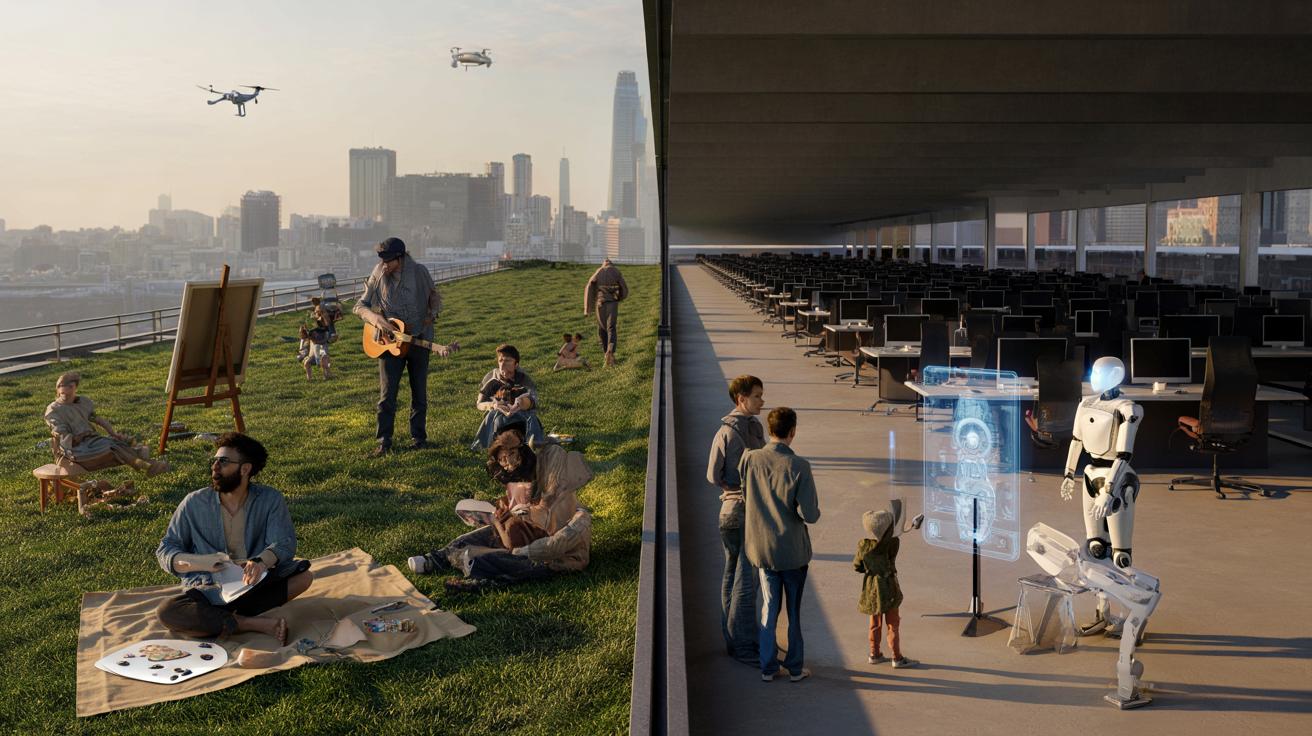
This is exactly the future that Elon Musk and Bill Gates keep describing — and that Nobel Prize–winning physicist Giorgio Parisi (or insert equivalent laureate) says is not just possible, but likely. Machines that design, negotiate, diagnose, write code, optimize logistics, even compose music. The big twist? The goal is not to keep us working faster. The goal, in theory, is to set us free.
You can already see the first draft of this future in small, almost ordinary scenes. A solo entrepreneur running what feels like a “one-person multinational” thanks to AI assistants. A doctor using software to summarize patient histories in seconds, freeing ten extra minutes for face-to-face conversation. A factory that used to need three shifts of workers, now monitored by a handful of technicians and a control room full of screens.
In South Korea and Japan, some companies are openly testing four-day weeks because automation quietly takes over the “boring bits”. In Europe, a few municipalities are experimenting with guaranteed income pilots. None of this is science fiction. It’s just unevenly distributed.
The physicist’s reasoning is brutally simple. Productivity has always risen when we automate tasks. From the spinning jenny to the microchip, each wave of technology allowed humans to do more with less time. The difference with AI is the range: we’re not just automating muscles, we’re starting to automate minds.
If a software agent can handle customer service, draft your emails, prepare your tax return, and even negotiate your phone bill, the number of hours that genuinely “need” you shrinks. Economic output can keep going up, even if the number of classic nine-to-five jobs goes down. The math points to a future with plenty of wealth, less traditional employment, and a lot of “free” hours to fill.
From job to role: how to survive in a world of too much free time
The physicist suggested a simple, almost counterintuitive exercise: stop thinking in terms of “job”, start thinking in terms of “role”. A job is a contract that can be automated. A role is a set of contributions that only you, with your particular mix of skills, quirks, and values, can bring.
Take a blank page and split it into three columns. In the first, list everything you do in a week that a smart machine could probably do tomorrow. In the second, the tasks that need human presence, judgment, or trust. In the third, write what you’d do if money was covered but you still wanted to feel useful. Those last two columns are where your future resilience lives.
Most people skip this kind of reflection and cling to their job title like a life raft. “I’m a project manager.” “I’m a paralegal.” “I’m a marketing analyst.” Then AI shows up and quietly absorbs 60% of what that title used to mean. We’ve all been there, that moment when a new tool makes something you spent years learning look almost trivial.
The emotional trap is to resist the tools instead of updating your identity. A lawyer who insists they’re “above” using AI research assistants will simply lose to the colleague who delivers better work, faster, with fewer late nights. Let’s be honest: nobody really does this every single day, but the ones who experiment regularly are building a very different future for themselves.
The Nobel physicist framed it with a blunt quote that stayed with many in the room:
“Machines will not ask for meaning. They will not feel boredom. That will be our problem, not theirs.”
Then he drew a small box on the board and listed what he believes humans will still deeply own:
- Curiosity that jumps across disciplines with no clear purpose
- Trust in relationships built over years of shared experience
- Responsibility for other humans: care, teaching, mentoring
- Play and culture: creating stories, rituals, jokes, beauty
- Moral judgment in messy, real-world situations
These are not bullet points for a résumé. They are the raw material of roles that survive when the old job grid starts to flicker.
➡️ A polar vortex disruption is on the way, and its magnitude is almost unheard of in March
➡️ A new maker of passenger jets arrives: it’s not Chinese but Indian
What if “unemployment” becomes the default setting?
The most unsettling part of the physicist’s argument is not the tech itself. It’s the social lag. Our institutions are still wired around the idea that your worth comes from your occupation. What happens when millions of people technically don’t have “jobs”, but the economy keeps running smoothly on machines and a much smaller human workforce?
Politicians use words like “universal basic income” and “retraining programs”. Economists talk about “decoupling work from income”. On the ground, though, the question is much more intimate: who are you on Monday morning if nobody expects you at an office, a shop, a classroom, a plant?
Some early experiments give a glimpse of both the promise and the risk. In Finland’s basic income trial, people who received a guaranteed monthly payment reported lower stress and slightly higher well-being, but they didn’t all turn into artists, volunteers, or startup founders overnight. Many just felt a bit safer.
In regions where factories closed and never came back, entire communities show the darker version of this story: people technically “free” from work, but adrift, isolated, sometimes numbing that emptiness with addictions. Free time without structure can slowly become a trap. *The physicist’s warning was clear: if society removes jobs, it must actively build new forms of belonging, or pay the price in loneliness and anger.*
He pointed to three quiet skills that might matter more than any coding bootcamp in the next decades:
- Designing your own schedule: turning empty days into meaningful routines
- Joining or creating communities: clubs, cooperatives, local projects, online circles
- Learning new skills in short, intense sprints rather than long, one-shot careers
As he put it, “You will live many small professional lives, not one big one.” That’s not a motivational poster. That’s a logistical challenge for families, schools, and cities. Your kids might grow up in a world where “What do you want to be when you grow up?” simply stops making sense.
| Key point | Detail | Value for the reader |
|---|---|---|
| AI shifts work, not just tasks | Mass automation can keep the economy productive while reducing classic full-time jobs | Helps you anticipate career changes instead of being blindsided |
| Free time needs structure | More hours off work can lead to boredom or anxiety without clear roles and routines | Gives you a reason to design your days, not just your résumé |
| Roles outlast job titles | Curiosity, trust, care, and judgment become core “human advantages” | Shows where to invest your energy so you stay relevant and grounded |
FAQ:
- Question 1Are Elon Musk, Bill Gates, and this Nobel physicist really talking about the same future?Broadly, yes. They all describe a world where AI and robotics handle a huge share of current jobs, productivity stays high, and societies must invent new ways to distribute income and meaning.
- Question 2Does this mean my job will disappear soon?Not necessarily soon, and not always completely. Parts of your job will likely be automated first. The key is to move upstream: focus on human relationships, complex decisions, and creative problem framing.
- Question 3Should I learn to code to be safe?Coding helps, but it’s not a magic shield. Pair technical literacy with “soft” strengths: communication, ethics, facilitation, teaching, negotiation. Those are harder to replace.
- Question 4What can I do if my work already feels threatened by AI?Start by mapping what AI can do in your field, then deliberately specialize in what it cannot do well yet. Talk to peers, join forums, test tools instead of avoiding them. Curiosity is a survival instinct here.
- Question 5Will more free time actually make people happier?The honest answer: it depends what we do with it. Free time that’s filled with relationships, projects, learning, and rest can be deeply satisfying. Free time spent alone, anxious and disconnected, can be crushing. The technology won’t decide that part for us.