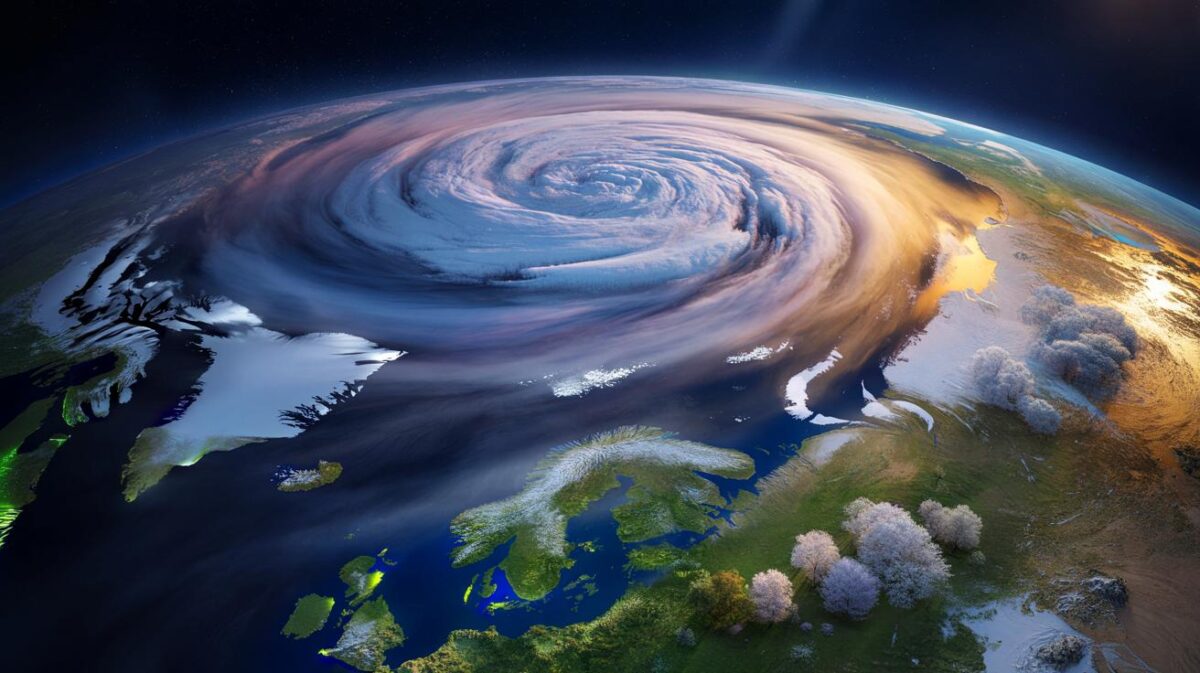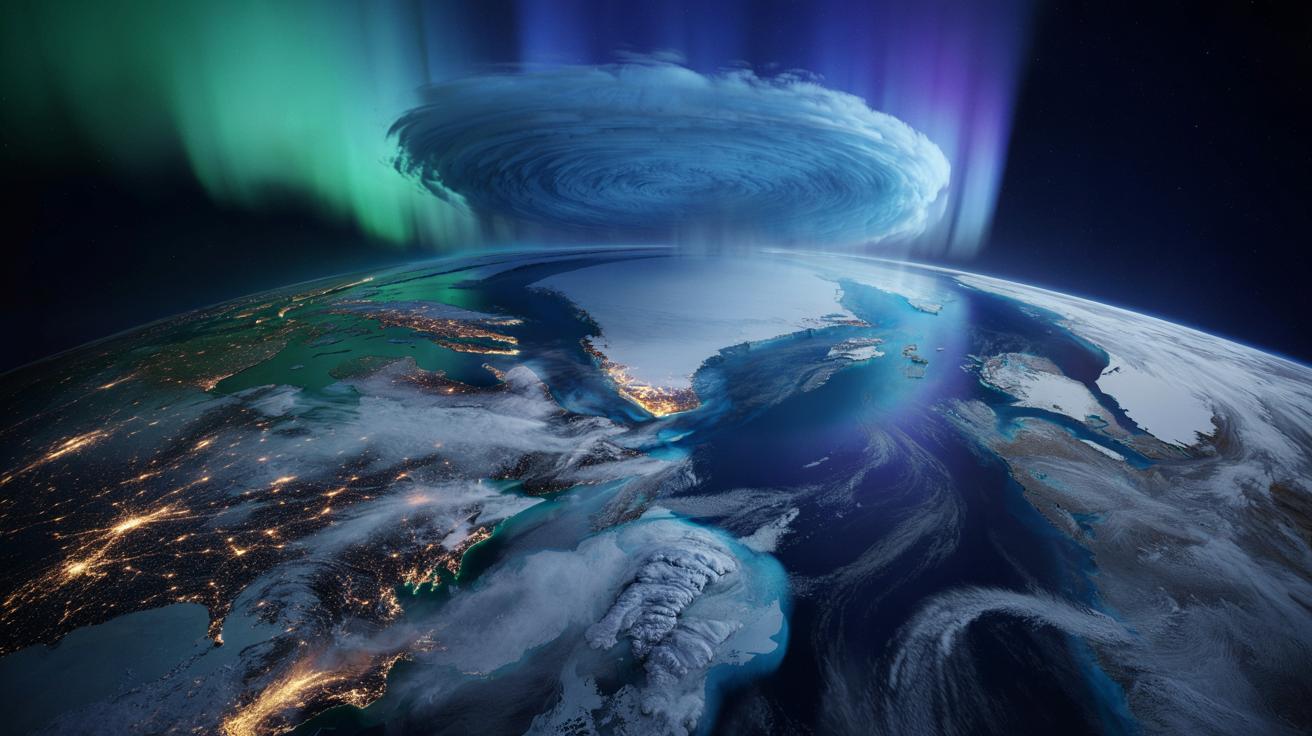
The alerts started as a quiet trickle on a Tuesday morning. A few lines buried in a specialist forecast, a tweet from a meteorologist who doesn’t scare easily, a strange lurch in those spaghetti plots that weather geeks obsess over. Above the Arctic, something was cracking open: the polar vortex, that icy guardian of winter cold, was wobbling out of line.
Most people scrolling their phones at breakfast had no idea that, 30 kilometers above their heads, the atmosphere was rewiring itself.
The sky looked the same. The air felt normal.
But the maps on expert screens were suddenly turning weird, violent colors.
A big shift was coming.
The polar vortex is misbehaving – and it won’t stay in the Arctic
High above the jet stream, the polar vortex usually whirls like a cold, disciplined carousel over the Arctic. When it’s strong, it locks frigid air in place, away from cities and farms and highways further south. Right now, that carousel is slowing, stretching and likely about to snap into messy pieces.
Scientists call this a “sudden stratospheric warming” event, a clunky name for a brutal reality: the stratosphere rapidly heats up, the vortex stumbles, and the cold escapes.
Not all at once. Not everywhere at the same time.
But when it does, the weather below can flip like a light switch.
If you want to know what a disrupted polar vortex can do, ask anyone in Europe about February 2018. That winter, a dramatic vortex breakdown unleashed the “Beast from the East,” sending Siberian air roaring into Western Europe. Trains froze on tracks in the UK, pipes burst in Paris, and fields in Italy were glazed with unexpected ice.
➡️ A new maker of passenger jets arrives: it’s not Chinese but Indian
➡️ A polar vortex disruption is on the way, and its magnitude is almost unheard of in March
Or think of Texas in February 2021, when Arctic air knifed deep into the US South. Millions lost power. Homes flooded from ruptured pipes. What looked like “just” a cold wave on paper turned into a cascading crisis: energy, water, roads, health.
Those scenes started the same way. With a quiet wobble high above the pole that most people never saw.
This time, models are hinting at another serious disruption. The stratosphere above the Arctic is projected to warm sharply, shredding the tight circular winds of the polar vortex. When that circulation breaks, chunks of cold air can spill south in pulses.
That doesn’t only mean “colder winter”. It means reshuffled storm tracks, stalled weather patterns and strange juxtapositions: ice storms where rain was expected, rain on snowpack, freak thaws followed by brutal freezes.
The atmosphere works like a set of connected gears. Twist one hard enough, and the rest grind and judder in response.
From vortex to your street: how chaos spreads on the ground
The first practical step now isn’t to panic, it’s to zoom in from the Arctic to your own front door. Watch the jet stream forecasts. When the polar vortex weakens, the jet stream often bends like a loose hose, digging further south in some regions and whipping north in others. That’s your early warning sign.
If that bend sets up over your region, think in layers. Layers of clothing, layers of preparedness, layers of time.
Have a simple “cold snap kit” ready: blankets, battery lights, basic food, backup charging.
Not a bunker, just a buffer.
Most people only react once the first big headline hits: “Historic cold wave on the way.” By then, store shelves strip fast, road salt runs low, and plumbers’ phones melt from the number of calls. You can almost feel the collective stress building with every updated forecast map.
We’ve all been there, that moment when you’re standing in a supermarket aisle, holding the last sad bag of rock salt, wondering why you waited so long.
The same lag happens at the city level. Road crews rush, hospitals quietly brace, grid operators start late-night calls. That delay is what turns a sharp but manageable cold outbreak into a full-blown emergency.
From a scientific angle, a disrupted polar vortex opens the door to “cascading” hazards because weather systems stop behaving like a smooth sequence and start behaving like falling dominoes. One extreme piles onto another.
A deep freeze hits first. Then a heavy snowstorm rides the same jet stream dip. Then a quick thaw melts that snow, sending water into rivers already choked with ice.
As one climate scientist put it in a briefing this week:
“When the polar vortex breaks down, we stop thinking in single events and start thinking in chains of events. The risk isn’t just the cold. It’s cold on top of fragile systems, on top of aging infrastructure, on top of a warming climate.”
Those chains often look like this:
- Arctic outbreak → overloaded power grid → rolling blackouts in sub-freezing temperatures
- Heavy snow → ice storm → fallen trees → blocked roads and delayed emergency services
- Freeze → quick thaw and rain → flooded basements and landslides on saturated slopes
What you can actually do before the vortex roulette spins your way
Start with your own micro-climate: your home, your commute, your daily rhythm. Look at a 10–15 day forecast from a reliable national weather service and one independent source. You’re not trying to out-guess the models. You’re scanning for patterns: repeated mentions of “Arctic air”, “blocking high” or “prolonged cold”.
Then do a simple 30-minute walk-through of your place. Feel around windows for drafts. Check where your water pipes run, especially in basements, crawl spaces or exterior walls.
Wrap what you can, even with basic insulation or old towels and tape.
A bit of attention now often beats an expensive, miserable emergency repair later.
People often think polar-vortex headlines are overblown, so they brush them off until the cold is literally at the door. There’s also a kind of fatigue: so many “unprecedented” events in recent years that the mind just tunes out. That’s understandable.
Still, there’s a sweet spot between doom-scrolling and denial. Focus on practical, boring steps: knowing where your shutoff valves are, clearing gutters before a freeze–thaw cycle, keeping your car above a quarter tank.
Let’s be honest: nobody really does this every single day.
But doing a bit of it during the week before a forecast disruption can free you from that frantic, scattered feeling when the wind suddenly shifts.
One emergency planner in Minnesota told me something that stuck:
“Our goal isn’t to scare people with polar vortex talk. It’s to buy them 48 hours of calm before everyone else starts to panic. Two days of quiet preparation can change the whole story of a storm.”
If your region ends up in the path of the disrupted vortex, these small actions matter:
- Charge before the crowds: Top up power banks, recharge tools and check flashlights while the sky is still blue.
- Think heat, then water, then info: Extra blankets and layers, some stored drinking water, and a battery radio or reliable app.
- Protect the weak links: Elderly neighbors living alone, outdoor workers, pets, and anyone dependent on powered medical devices.
- Plan your “one bad night” scenario: Where would you sleep if the heating failed for 12 hours? Answer that now, not at 3 a.m. when the furnace dies.
*The polar vortex disruption is a global story, but your experience of it will be intensely local.*
Living with a shakier sky
What makes this looming polar vortex disruption unsettling is not just the science, it’s the feeling that the seasons themselves are losing their script. Winters that used to be steady now swing from balmy to brutal in days. Regions that once shrugged at cold snaps now find that the stakes are higher, because more people, more tech and more supply chains sit in the firing line.
This doesn’t mean every forecast disruption will deliver a catastrophic freeze where you live. Some years, the vortex stumbles and your region just gets a bit colder, a bit snowier, then moves on. Other times, the dice land differently, and your town becomes the next case study in cascading impacts.
The plain truth is: the atmosphere doesn’t care about our comfort zones, our work calendars, our weekend plans. It moves on physics, not fairness.
Yet inside that reality, there’s room for something empowering. Paying attention to these big atmospheric shifts can feel like a form of quiet resistance: against surprise, against helplessness, against the idea that we’re only ever victims of the weather.
As this disruption unfolds, the most useful thing you can do is stay curious, stay lightly prepared, and talk about it with others. Family, co-workers, neighbors, the group chat that always wakes up when the first snowflake falls.
Weather used to be small talk. Now it’s closer to a shared civic conversation.
And this winter, that conversation may start 30 kilometers above the Arctic, with a vortex that no longer wants to stay in its lane.
| Key point | Detail | Value for the reader |
|---|---|---|
| Polar vortex disruption | Sudden warming in the stratosphere weakens and deforms the Arctic cold core | Helps explain why extreme cold and strange patterns may appear far from the pole |
| Cascading hazards | Cold waves, heavy snow, ice, rapid thaws and flooding can arrive in tight sequence | Shows why this isn’t “just another cold spell” but a chain of risks to anticipate |
| Practical preparation | Simple home checks, basic supplies, and attention to local forecasts | Turns alarming headlines into concrete, manageable actions at household level |
FAQ:
- Question 1What exactly is the polar vortex, in simple terms?
It’s a large, long-lived whirl of cold, low-pressure air high above the Arctic, spinning like a giant atmospheric top. When it’s strong and stable, it keeps the worst of the polar cold locked up near the pole.- Question 2Does a polar vortex disruption always mean extreme cold where I live?
No. It increases the odds of Arctic air spilling south somewhere, but the exact regions depend on how the jet stream bends. Some areas get harsh cold, others stay mild or just unsettled.- Question 3Can we link this disruption directly to climate change?
Scientists see growing evidence that a warming Arctic and shrinking sea ice can influence the polar vortex and jet stream, making disruptions more likely or more impactful, though the exact links are still being studied.- Question 4How far ahead can experts see a polar vortex event coming?
Stratospheric changes can be spotted a couple of weeks in advance. Translating that into precise local impacts is harder, so the detailed forecasts often sharpen 5–10 days before the cold hits.- Question 5What’s the one thing I should do if my region is in the risk zone?
Treat it like a high-impact storm: check your heating, insulate vulnerable pipes, stock a few days of essentials and keep an eye on updates from trusted local meteorologists and emergency services.